
Craniosacral Therapy Helps Restore Balance in an Inflamed Knee
August 7, 2026
Learning to Feel Our Movements Rather than Simply Thinking About Them
October 14, 2026Life Is Not Static: The Art of Movement and Awareness
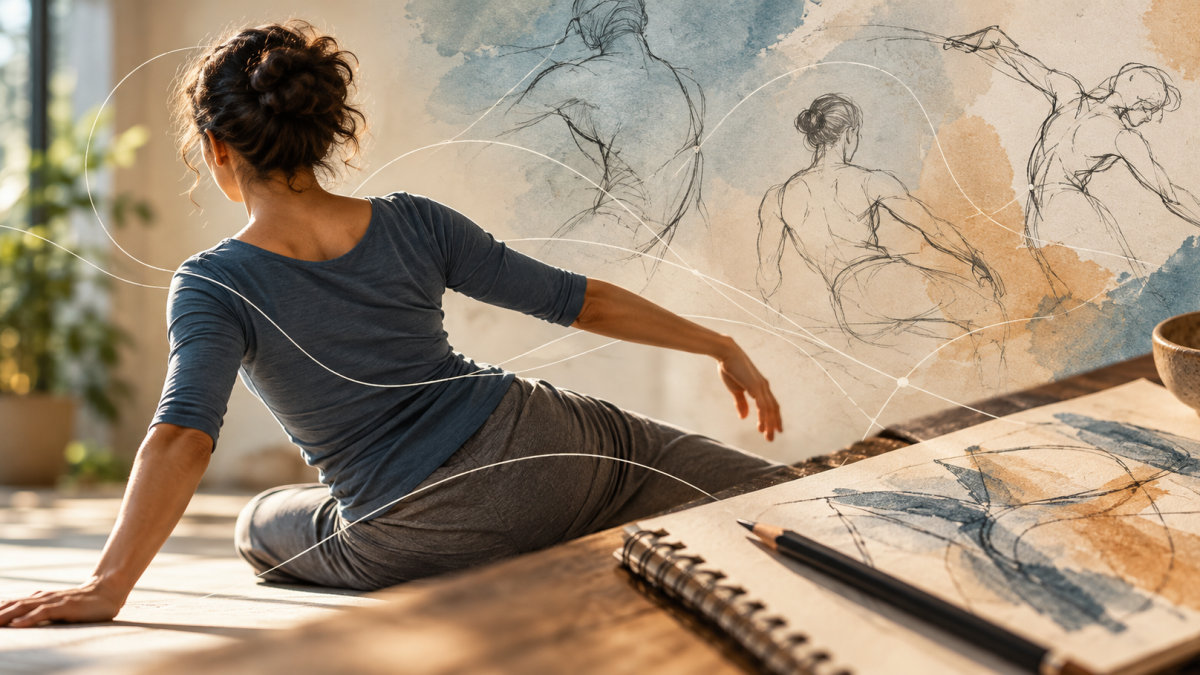
Life is not static. Everything is in motion, constantly changing and adapting. Every part of us exists in relationship to every other part, working together as a dynamic, functional whole.
Our bodies are no different.
We don’t move in isolated segments. Every movement involves a conversation between different parts of the body. When we reach for something, turn our heads, or take a step, countless relationships are at work. The feet, spine, shoulders, arms, and even our breathing participate in the movement.
It’s not just about individual parts. It’s about how everything works together.
This is one of the fundamental principles of the Feldenkrais Method. Rather than focusing solely on correcting an individual part of the body, Feldenkrais explores how the entire person organizes movement. When we become aware of these relationships, we discover new possibilities for moving with greater ease, comfort, and freedom.
Movement Is an Art
In many ways, Feldenkrais is like creating a work of art.
Think about an artist beginning a drawing. They make a mark, observe it, and then make another. Each new mark changes the relationship between the shapes, values, colors, and spaces on the page.
The artist doesn’t necessarily know exactly how the finished piece will look. Instead, the image gradually emerges through observation, experimentation, and discovery.
Movement works much the same way.
As we move, we can begin to notice how one part of the body influences another. A small change in the position of the pelvis might affect the shoulders. A different way of moving the head might change how the spine responds. Even the simplest movement can reveal something about the whole.
Nothing is left out. Every part contributes to the larger picture.
Don’t Be Afraid to Make Mistakes
An artist doesn’t learn by making only perfect marks. Experimentation is part of the creative process. Sometimes an unexpected line leads to an entirely new direction.
The same is true of movement.
In Feldenkrais, there is no need to force a movement or strive to get it right. Instead, we explore. We try something, notice what happens, and perhaps try it a different way.
What feels easier? What feels more comfortable? What changes when we slow down or approach a familiar movement from a different direction?
What we might initially consider a mistake can become an opportunity to learn something new.
By letting go of the need to perform a movement correctly, we give ourselves room to discover possibilities we may never have considered.
Observe and Proceed
Awareness is at the heart of this process.
When we pay attention to how we move, we begin to recognize habits and patterns that ordinarily go unnoticed. Some of these patterns serve us well. Others may create unnecessary effort, tension, or discomfort.
But awareness gives us choices.
We don’t have to immediately correct or change what we notice. Sometimes the most important thing we can do is simply observe, with curiosity rather than judgment.
Like an artist stepping back from a drawing, we begin to see the relationships that make up the whole.
And from that awareness, something new can emerge.
Look. Observe. Explore. Proceed.
Life is not static. Neither are we. There is always the possibility of discovering a new way to move, feel, and experience ourselves.